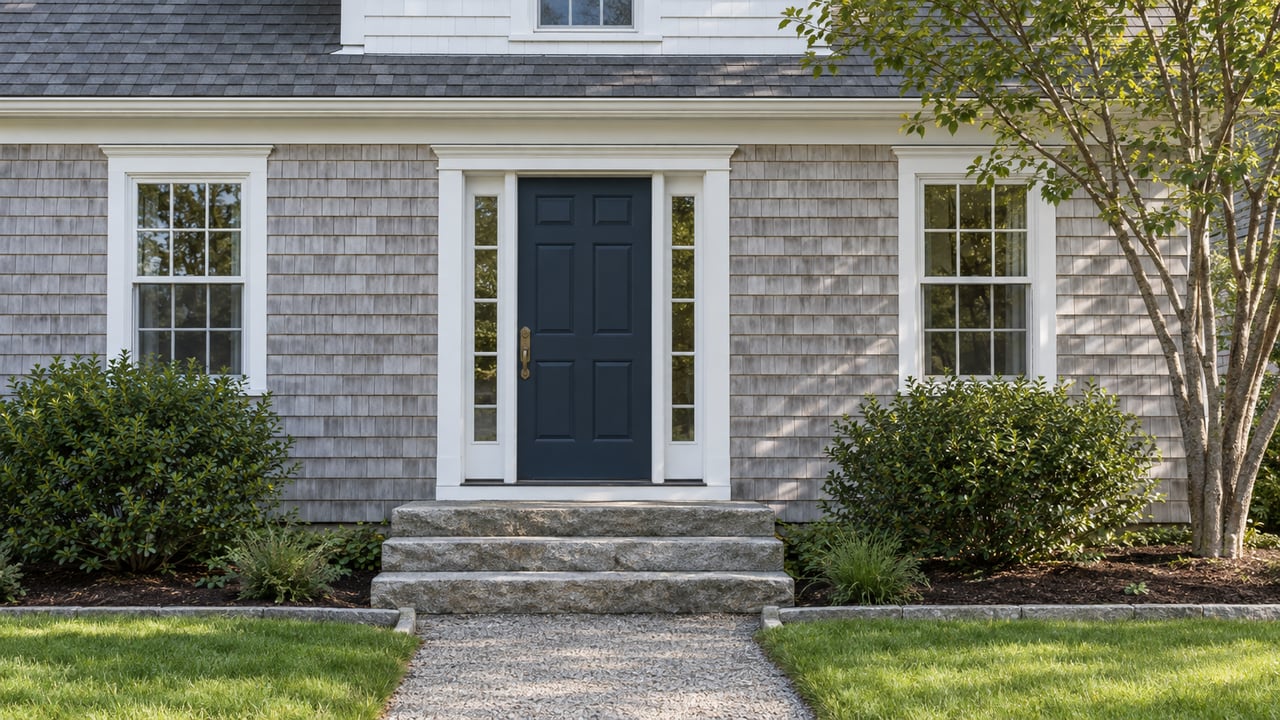
A waterfront listing near Duxbury Bay this year carried an unusual line buried in its remarks: buyer responsible for new Title V septic. The house was a Gambrel-style property built around 1920, the kind of home that shows up constantly in Duxbury's inventory of shipbuilding-era colonials and captain's houses. The disclosure wasn't a red flag. It was routine. In Duxbury, it's close to universal.
That's because Duxbury has no municipal sewer system anywhere in town. Every home, from a cottage off Tremont Street to a compound on Standish Shore, treats its own wastewater on site. A 2020 environmental filing for a residential project on Keene Street states plainly that there is no municipal sanitary sewer service in that part of town and that wastewater will go to private septic systems designed under Duxbury Board of Health regulations and the state's Title 5 code. That's not an exception. It's the baseline for the entire town.
The State Sets a Floor. Duxbury Built a Higher One.
Massachusetts Title 5 is the statewide rule for septic systems, administered by the Department of Environmental Protection. Under the state's own guidance, a system inspection is generally required when a property changes hands, when a building is enlarged in a way that increases wastewater flow, and periodically to keep the inspection valid. A passing inspection is good for two years, or three years if the owner has documented annual pumping.
Duxbury layers its own rules on top of that floor, and the layer matters more than most buyers expect. According to the town's Board of Health, Duxbury requires a Title 5 inspection for any addition greater than 50 square feet, even if the addition doesn't increase flow to the system at all. A mudroom, a screened porch, a modest primary suite bump-out. None of these have to add a single extra bathroom or bedroom to trigger a full system review under Duxbury's rule. The state wouldn't ask for that. Duxbury does.
The town's rules go further on system condition, too. Cesspools are automatic failures under Duxbury's supplementary code, and seepage pits have to be located, opened, and physically inspected rather than assumed compliant. For a town full of homes built in the 1700s and 1800s, where a cesspool or an unmapped pit is a real possibility rather than a hypothetical, that standard turns a routine addition into a project with a much longer runway.
Where the Wetlands Clause Bites Hardest
There's a second layer buyers in Duxbury's waterfront neighborhoods should know about. The town's septic requirements include a carve-out for minor additions under 50 square feet: they can sometimes skip a full Title 5 inspection if no variances were required on the original system permit and the Conservation Agent confirms there are no wetlands within 150 feet of the existing system.
That's a narrow exception almost everywhere near the water. Powder Point, the peninsula neighborhood bounded by King Caesar Road and the Powder Point Bridge, sits along Duxbury Bay and the Bluefish River Inlet. Standish Shore is a waterfront peninsula reached only through Standish Street and Hall's Corner. Snug Harbor, one of the town's three commercial centers alongside Hall's Corner and Millbrook, sits directly on the working harbor. Homes in all three areas are exactly the kind likely to fall inside that 150-foot wetlands buffer, which means the lighter-touch exemption often isn't available to them in the first place. The oldest, most water-adjacent, most expensive housing stock in Duxbury is also the stock most likely to need the full review on even a small addition.
What the Price-Per-Square-Foot Number Is Actually Telling You
Here's where the regulatory detail turns into a market signal. As of July 31, 2026, the average home value in Duxbury stood at $1,131,969, up 5.1% over the prior year, a healthy pace of appreciation for the South Shore. The most detailed breakout available, covering the year ending December 2025, put the median sale price near $1.2 million, up 2.2% year over year. Ordinary numbers for a competitive coastal market.
The price per square foot for that same period tells a different story. In the year ending December 2025, Duxbury's median sale price per square foot reached $548, up 32.8% year over year. That's a large gap between how fast total sale prices were climbing and how fast the price attached to each square foot was climbing. When price per square foot rises far faster than overall price, it usually means one of two things: homes selling are smaller than before, or homes are being upgraded in place rather than expanded.
Duxbury's own septic rule gives a plausible mechanism for the second explanation. If adding 50 square feet to a house built in 1780 or 1920 means opening up the septic system for full inspection, absorbing months of engineering and permitting if the system doesn't pass, and potentially facing a $25,000 to $50,000 replacement on a lot where soil conditions and wetlands setbacks complicate the redesign, then the math tilts hard toward renovating within the existing footprint. Higher-end kitchens, primary suite overhauls, better finishes throughout the same square footage. That behavior would show up exactly the way this data shows up: total prices rising at a moderate clip while price per square foot climbs sharply, because sellers are pouring money into quality rather than size.
This isn't a claim about what any individual seller decided. It's a pattern the incentive structure predicts, and the price-per-square-foot number is consistent with it.
What This Means If You're Buying or Selling in Duxbury
If you're selling an older home, especially anything built before 1980 in Powder Point, Standish Shore, or near Snug Harbor, get the Title 5 inspection done early, not at the eleventh hour. If the system hasn't been pumped annually, your inspection window is two years instead of three, and a stale inspection can stall a closing. If you've made any addition over 50 square feet without a matching septic sign-off on file, expect a buyer's inspector or attorney to ask about it.
If you're buying, ask for the Title 5 report and the as-built system plan before you waive an inspection contingency, particularly on a pre-1950 property. Ask when the system was last pumped. If your plans include any expansion, even a small one, have a Title 5 inspector assess the existing system's location and capacity before you finalize architectural drawings. Discovering a septic constraint after you've paid for plans is a more expensive way to learn the same information.
If a system fails, Massachusetts allows two paths: the seller completes the repair before closing with sign-off from the Board of Health, or the parties agree to an escrow holdback covering the repair cost plus a contingency reserve. Some lenders won't allow a holdback, so confirm that with your loan officer before you count on it as a fallback.
A Few Straight Answers
Does every home sale in Duxbury require a Title 5 inspection? Under the state code, yes, for most residential transfers, unless the transaction falls under a narrow exemption such as certain transfers between family members. Duxbury adds requirements on top of that baseline, particularly around additions and system condition.
How long does a passing inspection last? Two years under the state rule, extended to three years if the system has been pumped annually with documentation.
Can I add a small addition without triggering Duxbury's septic rule? Only if the addition is under 50 square feet, doesn't increase flow, no variances were required on the system's original permit, and there are no wetlands within 150 feet of the system. On or near the water in Duxbury, that last condition is the one most additions won't clear.
What does a septic replacement typically cost in Massachusetts? Statewide guidance puts new systems in the range of $25,000 to $50,000, depending on lot size, soil conditions, number of bedrooms, and whether state variances are required, which adds review time on top of cost.
If you're weighing a purchase or a listing on Duxbury's waterfront and want a clear read on what a specific property's septic history means for your timeline and your budget, the Doran Hall Team can walk you through it before you're under contract, not after.