If you are under contract on a home in Hull and your lender just mentioned flood insurance, here is the question worth asking before you sign anything: is the number they quoted based on how the National Flood Insurance Program actually prices risk today, or on rules that stopped applying in 2022?
That gap matters more in Hull than almost anywhere else on the South Shore. The town sits on a narrow peninsula jutting into Massachusetts Bay, and nearly every property has some degree of coastal exposure. Flood insurance is not an abstract line item here. It shows up in closing disclosures, in monthly escrow payments, and occasionally in a lender's request for paperwork that the rules no longer require. The problem is that a lot of the advice circulating among buyers, and even some loan officers, was written for a version of the program that no longer exists.
The Rule That Changed Four Years Ago
For decades, a home's flood insurance premium was largely a function of which zone it sat in on a FEMA map. If your zone began with an A or a V, you were in a Special Flood Hazard Area, and if you had a federally backed mortgage, insurance was mandatory. Lenders often asked for an elevation certificate, a surveyor's report on how high your first floor sits relative to expected flood levels, because that certificate helped set your premium.
In April 2022, FEMA rolled out Risk Rating 2.0, the biggest overhaul to NFIP pricing since the program began. Premiums are now calculated using property-specific factors rather than a flat zone-based category, and flood zone alone no longer determines your rate. One consequence that gets missed in a lot of buyer advice: elevation certificates are no longer universally required for NFIP pricing. Some lenders still ask for one, particularly on high-risk parcels, but it is now a lender's choice rather than a program requirement. If nobody has told you why the appraisal packet includes a request for a certificate, it is worth asking your loan officer directly whether it is actually necessary for your specific loan, or a holdover habit from before 2022.
There is a second detail buyers rarely hear: an elevation certificate belongs to the property, not the person who paid for it. If a previous owner had one prepared, it can often be reused rather than commissioned again, which can save a buyer several hundred dollars in survey costs. Before assuming you need a new one, it is worth asking Hull's building or floodplain office whether a certificate is already on file for the address.
The Massachusetts Law Most Buyers Have Never Heard Of
Federal rules set the floor for how much flood insurance a lender can require, but Massachusetts adds a ceiling that a surprising number of buyers, and even some agents, never learn about. Under state consumer protection law, a mortgage lender in Massachusetts cannot require a borrower to carry flood coverage in an amount greater than the outstanding balance of the loan. In practice, that means if your loan balance is $500,000, a lender cannot force you to insure the full replacement value of the structure if that number is higher.
This is not a hypothetical protection. Buyers occasionally get quoted for more coverage than the law allows, either because a lender is applying a national policy without accounting for the Massachusetts limit, or because nobody flagged the discrepancy. If your flood insurance requirement looks larger than your loan balance, it is a fair and reasonable question to raise with your lender before closing.
What Hull's Town-Wide Discount Actually Requires
Hull participates in FEMA's Community Rating System, a voluntary program in which a community earns points for floodplain management practices that exceed the federal minimum, and those points translate into a premium discount for every policyholder in town, not just those in the highest-risk zones. As of a 2021 designation cited in local reporting, Hull held a CRS class of 7 out of a possible 9, and the town has stated that its participation currently earns residents a reduction on flood insurance premiums.
Here is the part that gets flattened into a single misleading sentence in a lot of generic guides: that discount is not guaranteed to every property regardless of condition. A building found in violation of local floodplain management regulations can be excluded from the CRS discount until the violation is resolved. FEMA sent Hull a formal letter in March 2024 commending the town, writing that Hull had made real progress in "implementing the floodplain management measures" required to keep its standing in good order. That letter came alongside a town meeting vote to formally adopt a Floodplain Overlay District into Hull's zoning bylaws, a step the town needed to take to stay compliant with federal requirements by a July 2024 deadline.
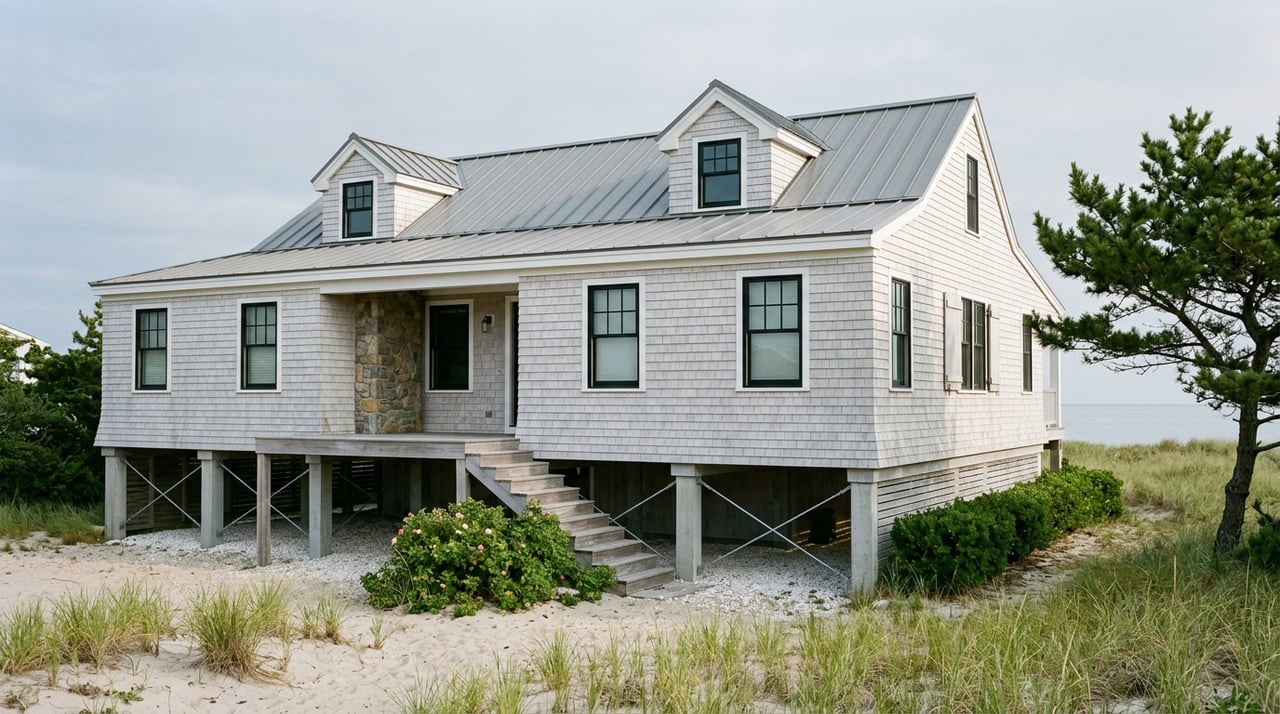
That zoning update did more than satisfy paperwork. Hull's Building Commissioner, Bartley Kelly, noted at the time that updated Coastal A zone designations now require an open foundation on piles for areas with wave action up to three feet, a construction detail that matters directly if you are buying a property with plans to rebuild or substantially renovate.
Why the Ground Is Still Moving Under These Numbers
None of this is settled history. Hull's coastline is under active construction and active planning at the same time, and both affect how flood risk and flood insurance will be priced in town over the next several years.
The Nantasket Avenue Seawall Project has been underway with a contractor rebuilding sections of concrete seawall and revetment along the shoreline, work that directly affects the town's flood protection infrastructure. In June 2026, the Boston Globe reported that Hull was eligible for $1.1 million in FEMA pre-disaster mitigation funding, specifically earmarked for repairing and enhancing shoreline protection along Harborview Road, part of a larger $189 million federal funding round for flood resilience projects across the country.
At the same time, the state's Department of Conservation and Recreation has been in early discussions with Hull officials about a coastal resiliency plan for Nantasket, one that could raise seawall height and reshape Hull Shore Drive. As of a May 2026 update reported by the Hull Times, DCR officials described concepts for a raised boardwalk and a "high tide park," but stressed the project has no formal timeline and remains in early stakeholder conversations.
None of these projects change your premium tomorrow. What they represent is the reason a CRS class, a flood zone boundary, or a coverage requirement that looks fixed on paper is actually a snapshot of ongoing town-level work. Buyers who treat the flood insurance quote on their initial loan estimate as a permanent number are missing that Hull's flood management posture, and the map beneath it, keeps getting revised.
| What Buyers Often Assume | What Is Actually True in Hull |
|---|---|
| Every waterfront property needs a costly new elevation survey | Elevation certificates are optional under Risk Rating 2.0 unless your specific lender requests one, and an existing certificate may already be on file for the property |
| The town discount applies equally to every home | Hull's CRS discount is tied to compliance with floodplain regulations, and violations can remove it until resolved |
| Lenders can require any coverage amount they choose | Massachusetts law caps required flood coverage at the outstanding loan balance |
What This Means If You're Under Contract in Hull
A few concrete steps are worth taking before you get to the closing table:
- Ask your lender to confirm, in writing, whether an elevation certificate is actually required for your loan, or whether it is a discretionary request.
- Ask Hull's building or conservation office whether an elevation certificate already exists for the property before paying for a new survey.
- Compare your required coverage amount against your loan balance. If it is higher, raise the Massachusetts coverage cap with your lender directly.
- Ask your insurance agent whether the property is currently in compliance with Hull's floodplain management regulations, since that status affects whether the CRS discount applies.
None of this is about avoiding flood insurance. It is about making sure the number you are asked to pay reflects the rules as they actually stand in 2026, in a town that is actively investing in its own shoreline.
What Hull Buyers Actually Ask Their Lender
Does every home in Hull require flood insurance? Only if the property sits in a Special Flood Hazard Area and carries a federally backed mortgage. Being on the peninsula does not automatically mean a property is mapped into a high-risk zone, so it is worth confirming the specific designation for the address.
Is the CRS discount automatic once I close? It applies to eligible NFIP policies in a participating community like Hull, but a property found in violation of local floodplain rules can be excluded until the issue is fixed. Confirming compliance status before closing avoids a surprise later.
Can I skip the elevation certificate entirely? Sometimes. Since Risk Rating 2.0, FEMA no longer requires one for most NFIP pricing, though individual lenders can still ask for one, especially in high-risk zones. Ask directly rather than assuming.
Buying in Hull means buying into a town that takes its shoreline seriously, from seawall reconstruction to a formal floodplain overlay district to active state and federal grant applications. Getting the insurance mechanics right is part of getting the purchase right. If you are weighing a home along the water in Hull, or anywhere else on the South Shore, the Doran Hall Team can walk you through what a specific property's flood zone and insurance requirements actually look like before you're locked into a number that may not reflect current rules. Request Your Home Valuation to start that conversation.